Feburary 2024 Visit on Thursday, February 29, 2024
Experiment Leads: Alison Block and Maggie Kumler
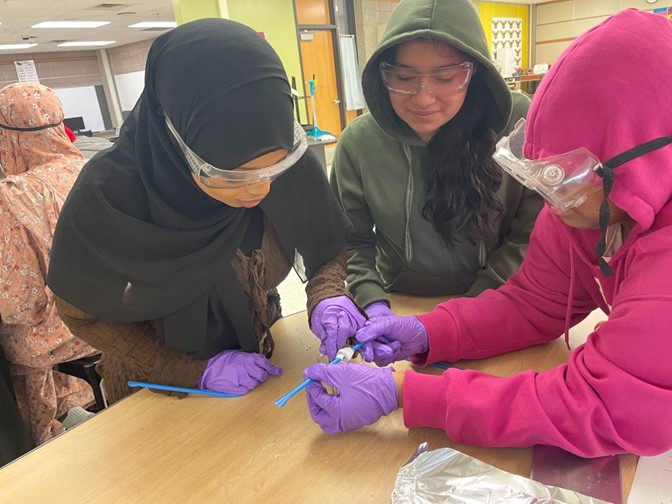
February’s visit allowed a ninth grade class at Heritage STEM Academy to explore polymer science. Alison and Maggie led a lesson summarizing their own research into polymers, comparing natural polymers and synthetic plastics, and defined key characteristics of step-growth polymerizations. To allow students to explore step-growth polymerization, we designed two experiments.
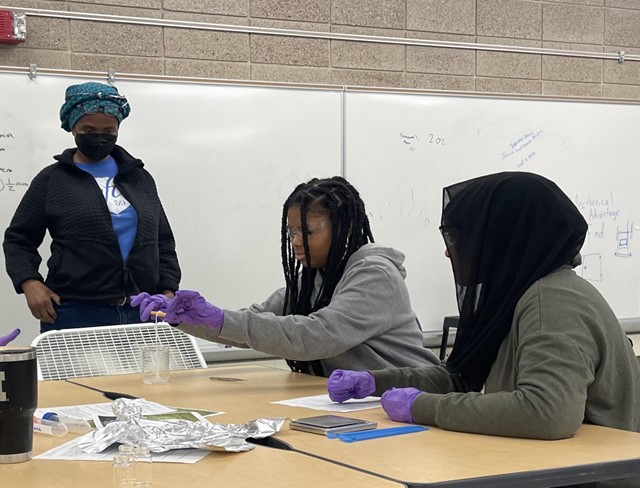
First, students synthesized Nylon-6,6 by carefully combining an aqueous solution of hexamethylene diamine (HMDA) and an organic solution of adipoyl chloride (AC). The components react at the solution interface, allowing the students to physically pull out the Nylon formed using tweezers. Removal of the polymer formed at the interface reestablishes contact between the interfaces, leading to continuous polymerization and the formation of a “rope”. The students explored the effect of spooling speed on rope quality and enjoyed competing with each other to see which group could recover the greatest mass of polymer from their solutions.
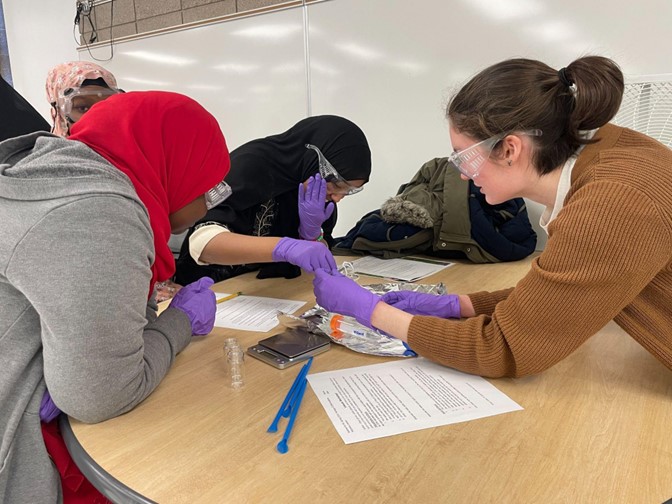
At the same time, students were also walked through a similar step-growth polymerization that resulted in a vastly different product: polyurethane foams. Students stirred food coloring into a solution of a polyol precursor and catalyst before Alison added a precursor solution with a multifunctional isocyanate. Upon vigorous mixing, the precursors reacted with each other to form a polyurethane network while the isocyanate also reacted with water to form an amine and carbon dioxide (thus creating the foaming effect). The mixtures overflowed out of the scintillation vial and solidified, forming a safe, colorful polyurethane foam. The students were thrilled about their hands-on experience with polymers and fun souvenirs from the experience.